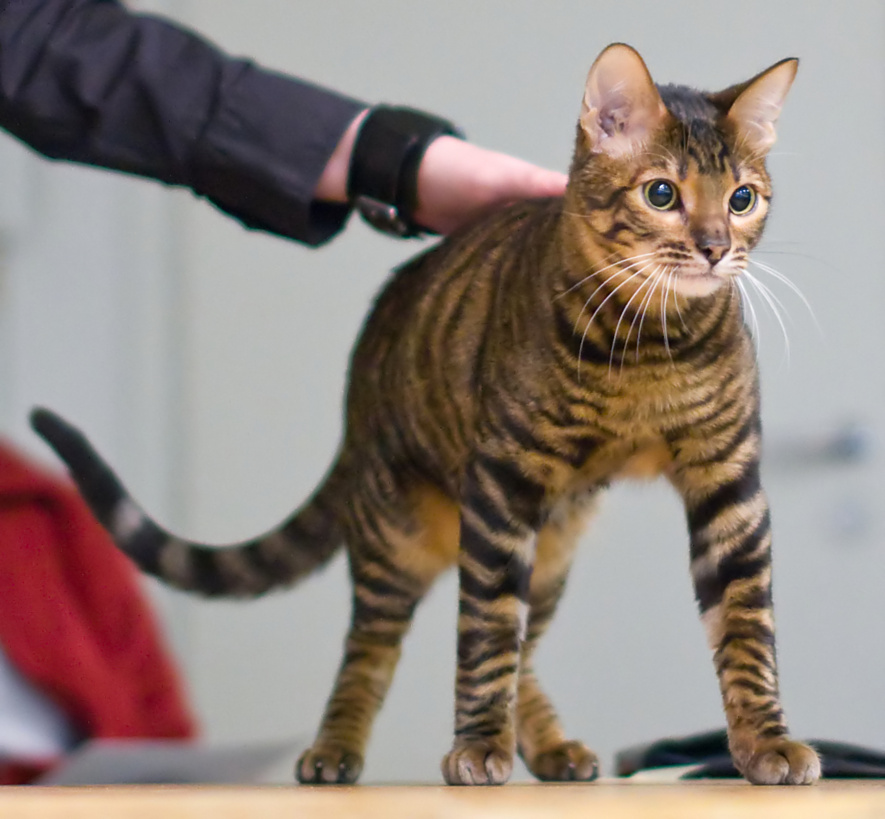
Bred to resemble a miniature tiger walking through your living room. Despite the wild appearance, the Toyger is a calm, friendly companion — the temperament of a house cat, the markings of a tiger.
- Origin
- United States
- Category
- shorthair
- Lifespan
- 10–15 yrs
- Size
- Medium
- Weight
- 2.7–6.8 kg
- Coat
- Short, dense, vertically striped mackerel tabby
- Colours
- Brown mackerel tabby — distinctive tiger-like markings
😺 Temperament
🏡 Best suited to
📊 Personality ratings
📜 History & origin
The Toyger was developed from the late 1980s by Judy Sugden (daughter of Bengal cat creator Jean Mill) with the goal of creating a domestic cat with the bold, branching stripe pattern of a tiger. She crossed Bengal cats with standard domestic shorthair tabbies selected for specific marking characteristics. The breed was accepted by TICA in 1993 and achieved championship status in 2007. Today's Toygers display the distinctive branching 'tiger-rosette' stripe pattern that sets them apart from regular tabbies.
🧼 Care & grooming
One of the lowest-maintenance coats of any breed — a weekly wipe is sufficient. Their calm temperament makes them adaptable to apartments and families. They respond well to training and can learn commands, walk on leads, and play fetch. Regular interactive play is important to keep them stimulated. They are social cats who enjoy company but are not as demanding as Siamese or Tonkinese.
🩺 Health notes
A relatively new breed still under development. Heart murmurs and eye conditions have been noted in some lines. Responsible breeders health test breeding pairs. Genetic diversity is a focus of the Toyger breeding programme — the breed's gene pool has been carefully widened to avoid the bottleneck problems common in new designer breeds.


.jpg)
.jpg)